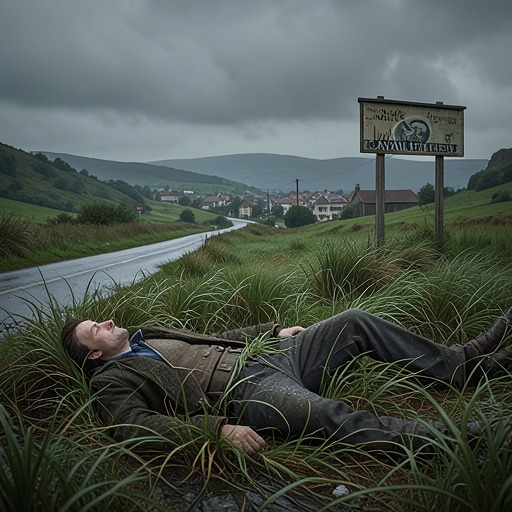
Silvio Luparello’s death during a tryst in the Pasture
The Shape of WaterSilvio Luparello’s death during a tryst in the Pasture is the case’s decisive rupture: a powerful, carefully groomed political figure is discovered dead in a locked car, exposed in circumstances that threaten to make his private life a public weapon. The scene initially suggests an ordinary death in an illicit setting, but his illness, the hurried disorder of his clothes, and his widow’s reading of the evidence make the death inseparable from political pressure and the attempted destruction of his public standing.
Discovery at the Pasture
At seven in the morning, Pino, working the stretch of the Pasture nearest the beach, noticed the nose of a car protruding from unusually dense bushes about twenty yards away. He approached cautiously, expecting that someone might still be there, but the car appeared vacant. From the passenger side he could make out a motionless man with his head thrown back, at first resembling someone asleep. The look and smell of the scene made Pino suspect something was wrong, and he called Saro over.
The large green BMW was locked. Its position against the shrub made the passenger-side door inaccessible, so Pino and Saro tried to see inside from where they could stand. Brambles scratched them as they leaned toward the car. Then they saw the man’s open, fixed eyes and understood that he was dead. Their terror came not simply from seeing a corpse but from recognizing the deceased as Silvio Luparello. That recognition immediately gave the discovery a public and political weight: this was not an unknown victim whose identity might remain uncertain.
The Body and the Medical Explanation
When Salvo Montalbano looked into the car, it was so hot that he likened its interior to a crematorium. The body before him sharply contradicted Luparello’s accustomed appearance. Luparello had been known as an elegant man, meticulously groomed; now his tie was missing, his shirt rumpled, his glasses askew, his jacket collar turned up on one side, and his socks sagged over his loafers. His trousers had been pulled down to his knees, his underwear showed, and his shirt and undershirt were bunched halfway up his chest. The exposure of his sexual organs made the contrast with his usual composure especially stark.
The doctor, Pasquano, treated the cause as obvious and asked whether Montalbano knew Luparello had undergone heart surgery. Montalbano did not: he had seen Luparello on television the previous Wednesday and thought him healthy. Pasquano explained that Luparello had had a double bypass in London, performed by a famous surgeon, and that the operation had been difficult. The medical history makes a sudden death plausible, but it does not settle what happened around it. Physical vulnerability offers one explanation for why Luparello died; it cannot by itself explain the condition in which he was found.
Disorder as Evidence
Luparello’s widow reads that disorder as evidence of force rather than mere carelessness. She points to the label on his underwear: it is visible because the briefs have been put on backwards. In her view, her husband would not have dressed himself that way and remained unaware of it, particularly because his diuretic required him to use the bathroom repeatedly during the day. The reversed underwear therefore becomes a small but consequential clue. She infers that he was naked when surprised and then made to dress in haste.
Her account locates the nudity in the little house at Capo Massaria, for which she had given Montalbano the keys. She does not claim that her husband was physically murdered. Instead, she argues that he was compelled, through threats or blackmail, to go to the disgraceful place where his body was discovered, and that an act of extreme violence led to his death. She considers it possible that stress or fear brought on his heart failure, while emphasizing that he was seriously ill after a difficult operation. This remains her interpretation of the circumstances, not a medical finding that the evidence cited here independently confirms.
Private Death and Political Consequence
The widow’s distinction between homicide and what she calls a political crime changes the meaning of the discovery. In her account, the plan was to discredit Luparello publicly, not necessarily to kill him. His death interrupted that plan, but did not erase its political effects. She says his allies were excluded from the new leadership, while Pietro Rizzo alone escaped that exclusion and instead benefited. The corpse’s humiliating exposure thus becomes more than a private indignity: it is linked to a struggle over reputation, succession, and political advantage.
The scene also unsettles the question of dignity in death. Before the investigation, Montalbano had discussed with Commissioner Burlando a book by Ariès on Western attitudes toward death. Burlando had maintained that every death, even the most abject, was sacred; Montalbano had sincerely rejected the idea that any death could be sacred. Faced with Luparello’s body, he wished Burlando were present. The contrast between a public figure’s carefully managed appearance and his exposed, disarranged corpse gives their abstract disagreement a concrete and disturbing form. The death begins as a locked-car discovery and a plausible cardiac collapse, but its clothing, setting, and political aftermath leave open the harder possibility that someone tried to turn a vulnerable man’s private encounter into an instrument of power.